Project background
Before the editor could do the whole loop
My workflow was to upload individual project files to ChatGPT, ask for a change, copy the result into the project, and test it locally. Then I would find the next file and do it again. The model could help write code, but I still had to carry the project context and move every change between tools.
The original Ghost AI was an early attempt at the integrated coding workflow now familiar from tools like Copilot: give the assistant project context, make changes where the files live, and get feedback without moving everything through a chat window. It was a prototype, not a claim of feature parity or a predecessor of Copilot.
Behind the project
Archived coding prototypeWhat I put together
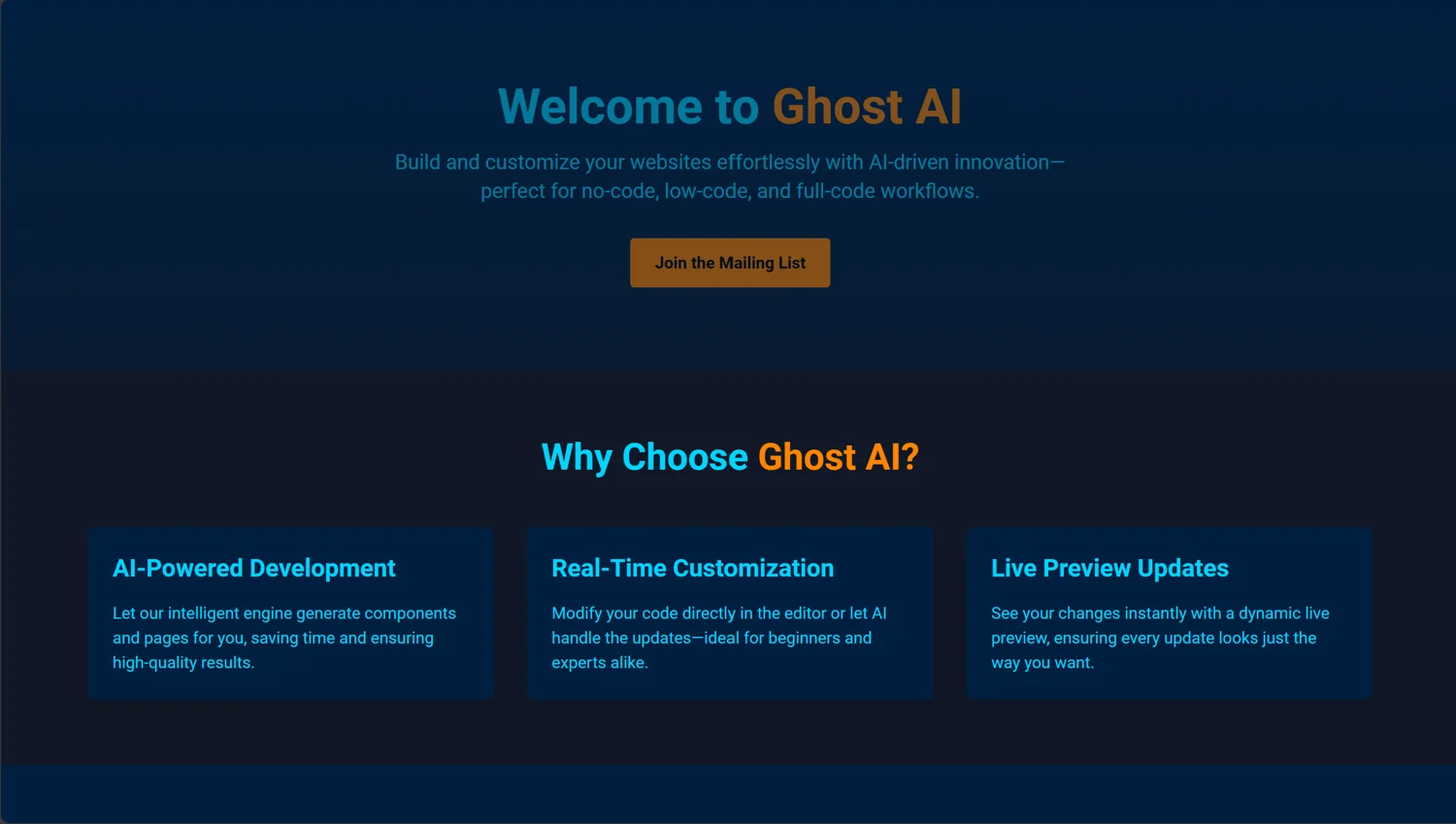
I built the prototype with AI assistance, effectively a file at a time. The goal was to connect an AI model to project files, let a user edit the code directly or request a change, and preview the result in the same workspace. The gallery image is the original landing page, not a capture of the workspace running.
The part that never got easy
Getting a project to run in a container was the hardest piece. An editor and a useful response are not enough if the project can’t reliably start and show what changed. I experimented with that execution layer but didn’t get it as dependable as I wanted.
Why I stopped
Integrated coding tools improved enough that keeping this early prototype going no longer made sense. I kept it in the archive because it shows a real workflow problem I wanted to solve. This is not the later business-assistant project that reused the Ghost AI name.
 Wandering Interest